Arabic
  English
  French
  German
  Spanish
  Portuguese
  Dutch
Dutch  Italian
  Russian
  Chinese
  Japanese
  Korean
  Indonesian
  Thai
Thai  Vietnamese
  Turkish
  Hebrew
  Hindi
Hindi 
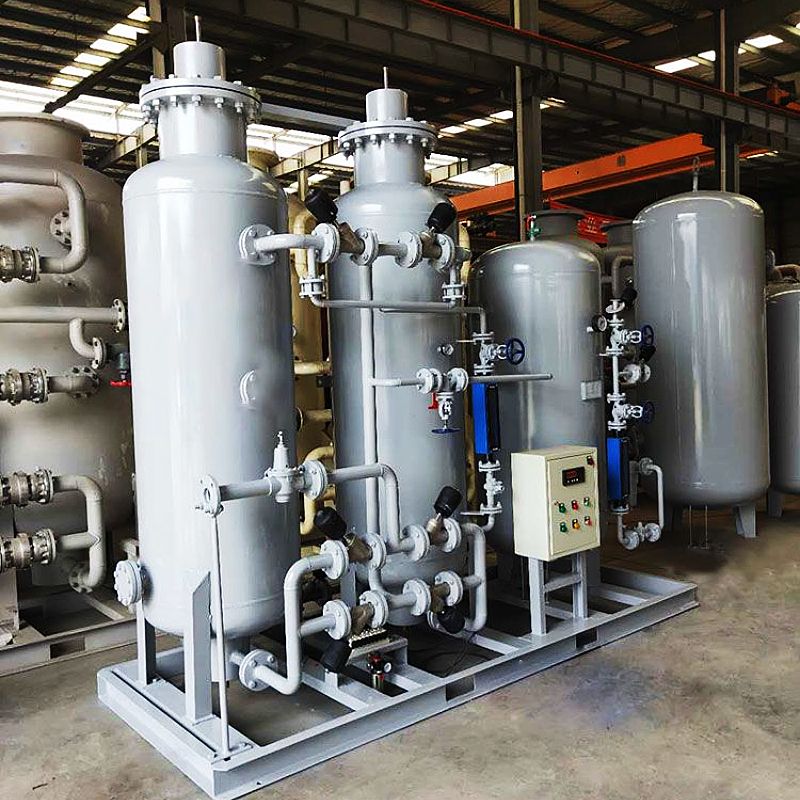
1. Core Principle: Pressure Swing Adsorption (PSA)
A PSA oxygen generator separates oxygen (O₂) from atmospheric air using selective adsorption—a process where a porous material (“adsorbent”) traps one gas (nitrogen, N₂) under high pressure and releases it under low pressure. Since air is ~78% N₂, 21% O₂, and 1% other gases (argon, CO₂), the goal is to isolate O₂ by removing N₂.
2. Key Components
Every PSA oxygen generator has 5 essential parts, each supporting the adsorption/desorption cycle:
|
Component
|
Function
|
|
Air Compressor
|
Draws in atmospheric air and compresses it (typically 5–10 bar) to enable adsorption.
|
|
Air Pre-Filter
|
Removes dust, oil, and moisture from compressed air—these impurities damage the adsorbent.
|
|
Dual Adsorption Towers
|
Two parallel towers filled with zeolite molecular sieve (the adsorbent). They alternate work to ensure continuous O₂ output.
|
|
Valve System
|
Automatically switches airflow between the two towers to control pressure (high for adsorption, low for regeneration).
|
|
Oxygen Buffer Tank
|
Stores produced O₂ temporarily to stabilize pressure and flow rate for end use (e.g., medical, industrial).
|
3. Step-by-Step Operation (Dual-Tower Cycle)
The generator uses two towers (Tower A and Tower B) that alternate between adsorption (O₂ production) and regeneration (N₂ release). A full cycle takes ~60–120 seconds.
Phase 1: Adsorption (Tower A Active, Tower B Regenerating)
- Air Input: Compressed, filtered air flows into Tower A (high pressure: 5–10 bar).
- N₂ Trapping: Zeolite molecular sieve has a strong affinity for N₂ (due to N₂’s larger molecular size and higher polarity). It adsorbs (traps) N₂ in its pores, while O₂ (smaller, less polar) passes through unimpeded.
- O₂ Collection: The pure O₂ (typically 90–95% purity; medical models reach 99.5%) flows into the buffer tank, then to the user (e.g., oxygen concentrators for patients).
- Tower B Regeneration: Meanwhile, Tower B is depressurized (to near atmospheric pressure). The low pressure reduces zeolite’s ability to hold N₂, so trapped N₂ is released (vented to the atmosphere). A small amount of pure O₂ may also be used to “purge” remaining N₂ from Tower B, speeding up regeneration.
Phase 2: Switching Cycles (Tower B Active, Tower A Regenerating)
- The valve system flips: Compressed air now flows into Tower B (starting adsorption and O₂ production), while Tower A is depressurized (releasing N₂ and regenerating).
- This alternation ensures continuous O₂ output—there is no gap in production.
4. Critical Why’s
- Why zeolite? Zeolite is a porous, aluminosilicate mineral with tiny pores (0.3–1 nm) that match N₂’s molecular size, making it highly selective for N₂ over O₂.
- Why two towers? A single tower would stop producing O₂ during regeneration. Dual towers let one produce O₂ while the other resets.
- Why pressure swing? Adsorption (trapping N₂) requires high pressure (increases zeolite’s N₂ capacity), while desorption (releasing N₂) requires low pressure (reduces capacity). The “swing” between pressures drives the cycle.
5. Typical Applications
PSA generators are used where on-site O₂ is needed:
- Medical: Home oxygen concentrators, hospital bedside units.
- Industrial: Metal cutting (oxy-fuel), wastewater treatment (aeration).
- Aquaculture: Oxygenation of fish tanks/ponds.